-
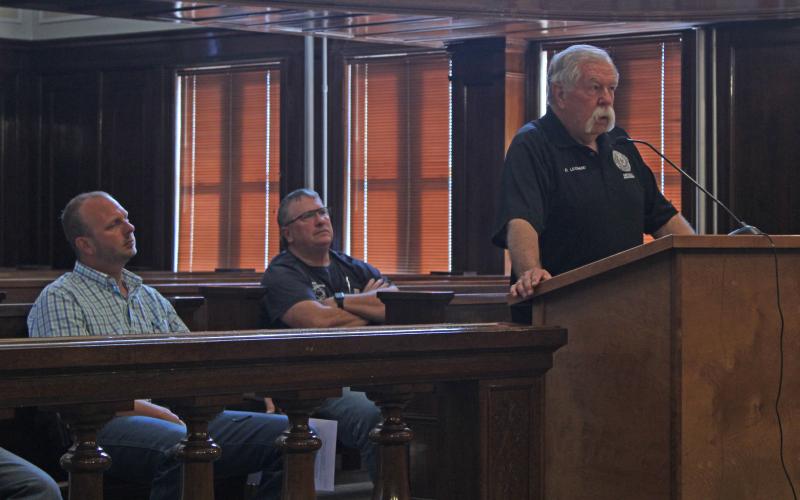 (Photo/Alex Kielar) Stephens County Emergency Management Coordinator David Leonard is looking into the possibility of the county being eligible for a funding opportunity regarding emergency warning systems connectivity that was recently announced by the acting Texas Comptroller.
Acting Texas Comptroller Kelly Hancock announced in late August a grant program that will expand broadband infrastructure across the state, particularly prioritizing projects that improve connectivity for flood detection and emergency warning systems in vulnerable areas.
There are $200 million in grants being made available through the Texas Middle Mile (TMM) Program after the Comptroller’s Broadband Development Office (BDO) issued a Notice of Funding Availability (NOFA) regarding the program. The NOFA was announced by Hancock Monday, Aug. 25.
The initial round of funding for this program is to prioritize projects that will help improve broadband access and connectivity regarding flood detection and emergency warning systems in the most vulnerable areas. Hancock said that some projects may receive up to 100% funding, while others will be eligible for up to 80% of the total project cost.
Stephens County Emergency Management Coordinator David Leonard has been working on getting funding in any possible areas for the county, especially following the devastating flooding that occurred July 4 in Kerr County and the history of flooding in Stephens County. Vulnerable counties like Kerr County, which have had trouble getting funding for such projects in the past, will likely be top priority.
During a weather warning workshop in June, Leonard referenced the current outlook of the emergency systems and their dire need of upgrades. The weather siren on top of the Breckenridge Fire station was reported to be over 100 years old after initially being installed in 1921.
Two major flooding incidents have occurred in Stephens County, one in October 1981 and the other in May 2016. The latter flood led to one death and more than a dozen individuals were rescued.
Leonard has also relayed a multi-layer notification situation for the county, from the National Weather Service Daily Forecast that he sends out via email, NWS weather alerts from his office and NWS weather alerts from Stephens County Facebook. Hyper-Reach is also used to deliver automated alerts to anyone who signs up. The last line of notification are the weather sirens.
Whether or not Stephens County is eligible for this funding opportunity is pending, but Leonard told the Breckenridge American that he has sent an email to the comptroller’s office stating the county’s situation and has yet to receive a reply.
“We’ve seen the devastation flash flooding can bring to Texas families and communities,” Hancock said. “This program will direct critical resources where they can make the greatest impact, deploying technology to save lives while we continue to expand access to affordable, reliable broadband.”
According to a press release sent out by the Comptroller’s office, the TMM Program is designed to close broadband gaps by building the next generation of extremely high-speed middle-mile infrastructure, which is the critical link between local networks and the internet backbone.
Expanding the middle-mile infrastructure backbone will make it easier and more cost-effective for providers to deliver last-mile service to homes and businesses, according to the press release. In addition, it also supports stronger weather-ready networks and encourages open-access systems that reduce community costs and improve consumer affordability.
Entities positioned to deliver significant community benefits, such as local governments, utilities and river authorities, are, according to the Comptroller’s office, the eligible applicants of the program.
“By allowing these organizations to compete for funding, the program ensures resources can be directed to projects that improve broadband service and provide the connectivity needed to strengthen public safety systems in flood-prone regions,” stated the press release.
BDO will also be holding a public comment period, and selected proposals will be posted to the agency’s website so that stakeholders can provide feedback before awards are finalized.
The submission period is through Thursday, Nov. 20 at 2 p.m. and the $200 million is expected to be divided up between four entities, with a maximum of $50 million per entity.