-
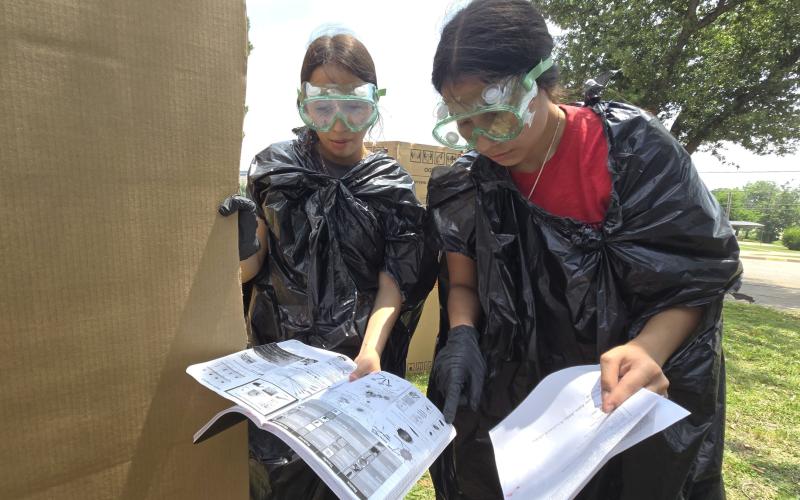 Two Breckenridge High School students look over blood spatter patterns as a part of the forensic science class. The students were split into investigator teams to create spatter patterns on cardboard boxes. (BISD Journalism/Contributed photo)
 -
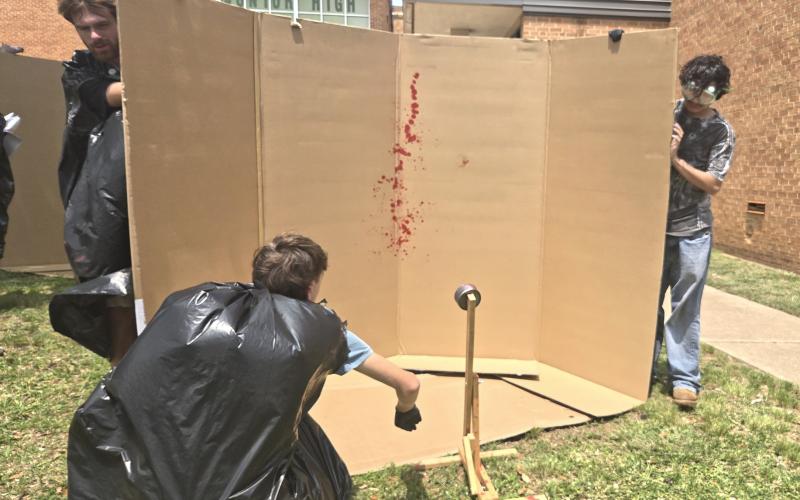 Students hold up a card board box as another student uses a tool to create a blood spatter pattern. The pattern was created by one of many investigative student teams in the forensic science class at Breckenridge High School. (BISD Journalism/Contributed photo)
 -
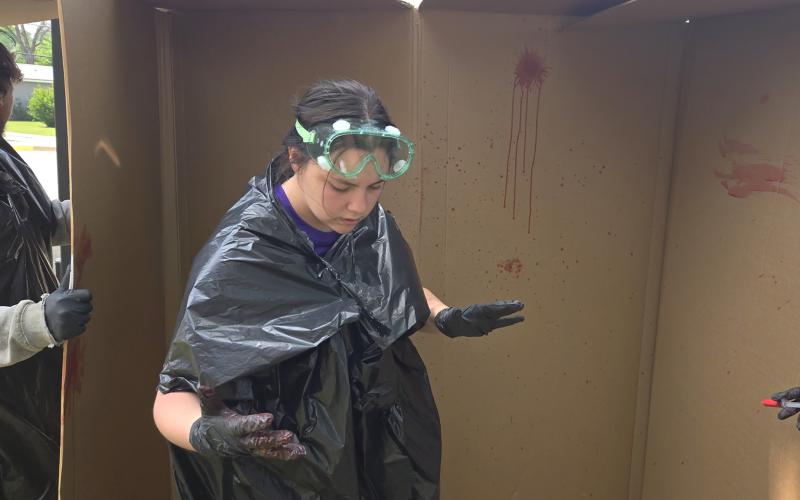 Students in the forensic science class at Breckenridge High School use different tools to make blood spatter patterns on cardboard. The students have been learning various aspects of crime scene investigations. (BISD Journalism/Contributed photo)
The next generation of crime scene analysts could be inspired at Breckenridge High School after forensic science classes studied mock crime scenes.
BHS teacher Kim Walker’s students across five classes have been busy inside and outside of the classroom studying blood evidence that is used to exonerate or convict suspects of crimes.
The students have also examined different types of surfaces and how blood droplets reacted to those surfaces, studied hair evidence, case studies of serial killers, lab safety and equipment, observation skills, deductive reasoning, finger and shoe prints, Miranda Rights and preservation of evidence from the crime scene to the courtroom.
“The students really enjoyed the unit over blood. They love the culminating activity of replicating various blood spatter patterns inside of a refrigerator box that represents the walls and stove or dishwasher boxes as the floors,” Walker said.
The students studied concepts that included blood components and functions, blood spatter patterns, blood types and Rhesus (Rh) factor, coagulation, antibodies and antigens and crime scene investigations.
“My students have tested blood spatter from various heights, measuring blood droplets to determine angle of impact, the direction the blood came from, what type of weapon was used, where was the victim or suspect located at the time of the crime and was the person walking slow, moving at a fast pace, or running based upon the direction of the blood droplets,” Walker said.
The students also determined the blood type by its coagulation of the Rh factor. This month, the students created crime scenes using cardboard boxes as walls and floors with blood spatter patterns.
“The students became detectives and dressed fashionably in trash bags, goggles, lab aprons, old T-shirts and gloves,” Walker said.
The students were provided a list of blood spatter patterns and items they could use to recreate those patterns found at crime scenes.
“The kids did an outstanding job of using what was available to them and their imaginations and creativity to reproduce the blood spatter patterns that were on their list to produce realistic looking bloodstains,” Walker said.
After the cardboard boxes dried, they were put inside a hallway where the students exchanged boxes with another detective team and analyzed the blood spatters inside their box. The teams marked the blood spatter patterns with sharpies produced from the other detective teams.
Walker said she loves watching the students transform into detectives and realize the importance of teamwork, enjoy learning, build self confidence and become collaborative communicators.
“Teaching high school forensics is an exciting and rewarding experience because it gives students an opportunity to work together and collaborate in investigative teams, to seek solutions and answers by trying to solve crime scenes based upon evidence and observation by using deductive reasoning, scientific method, perception and our five sense organs, to challenge my students to step outside the box and think critically and differently about a variety of situations that can occur in our everyday lives,” Walker said.