-
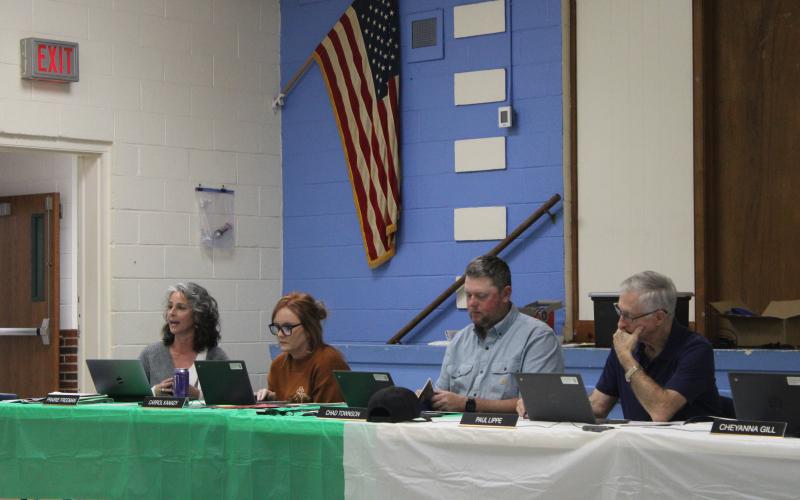 (Photo/Alex Kielar) Breckenridge ISD Superintendent Prairie Freeman, left, presents a Texas Strategic Leadership (TSL) report in partnership with Region 14, providing insight into the current outlook of the school district at a recent BISD board meeting.
Breckenridge ISD Superintendent Prairie Freeman recently presented a Texas Strategic Leadership (TSL) report in partnership with Region 14, providing insight into the current outlook of the school district.
The report, presented at the BISD school board meeting Monday, Nov. 10, provided landscape analysis looking at two main areas–student experience and critical enabling systems (teachers and talent).
“So what we did in the fall is we submitted a lot of data, and it was mainly our teachers and staff members who grouped together and got all the data together for two different kinds of areas,” Freeman said.
The report took numerous variables into account. Under student experience, it looked at whether all students were engaging in rigorous, grade-level content and instruction daily and whether students were experiencing a welcoming learning environment, along with other factors.
In the report, the landscape data revealed that classrooms at BISD demonstrated strong engagement and accessible academic support, but did also note there is room to strengthen consistency with variability in curriculum use, alignment, rigor and instructional practices. It also said this strengthening of variability could deepen students’ sense of real-world relevance and motivation.
A second question asked under student experience was whether students had access to and were completing strong, aligned career and educational pathways that led to high-wage and high-skill occupations. The landscape analysis revealed that BISD graduates show below-average Texas Success Initiative scores and low college and career readiness rates.
The analysis also describes limited individual guidance, a disconnect between student and family perceptions of Career and Technical Education (CTE) pathways and missed outcome bonuses related to performances on College, Career Military Readiness (CCMR). The data shows that just 22% of district students have completed a CTE pathway, while 36% have earned at least one industry-based certification.
“We know that we are leaving some money on the table…Our goal is to give our kids options after graduation,” Freeman said. “We don’t feel like we’re doing as good of a job in that area as we could and so that is a focus. Mr. Armstrong and Mr. Gibson are all working together to address those gaps.”
The data revealed that BISD demonstrated strong teacher-student-family relationships and high expectations related to academic achievement and a shared commitment to success. One possible need the data suggested was fostering more positive peer interactions and collaborative support amongst students.
Under critical enabling systems, the report looked at whether teachers were effectively supported to deliver a strong student experience and if talent systems were designed to recruit, retain and enable staff to deliver on the envisioned student experience.
The landscape analysis revealed that district teachers maintained a clear understanding and belief of the district’s instructional vision and implementation. The data did, however, reveal that a higher percentage of teachers have used supplemental materials instead of district adopted curriculum.
Next in the report it was revealed that instructional leaders of the district reported having limited time and resources to develop teacher capacity through collaborative planning, coaching and professional development.
Currently, the school district employs nine teachers with zero years of experience and 24 teachers with one to five years of experience. There were no instructional coaches dedicated to secondary campuses, which put a damper on new teachers being able to develop.
However, BISD implemented a New Teacher Academy which could help build the capacity in new staff.
The analysis revealed that BISD had a strong commitment to reward teachers for excellence, with 24 teachers being awarded a total of $385,301 through the Teacher Incentive Allotment (TIA) program. Teacher average salaries do trail that of the state, though, and the BISD retention rate was at 68%.
Almost 90% of BISD teachers were also rated proficient or above on Texas Teacher Evaluation and Support System (T-TESS) evaluations, with 41% earning accomplished or distinguished ratings–primarily at East Elementary and Breckenridge Junior High.
The next step in the process according to Freeman was for the steering committee to use the data to begin planning for the district’s envisioned future state.
In November and December, the steering committee is utilizing insights received from the landscape analysis to determine the envisioned student experience and strategic priorities. Then in January, the BISD board will be updated on the steering committee’s progress in defining the future priorities.